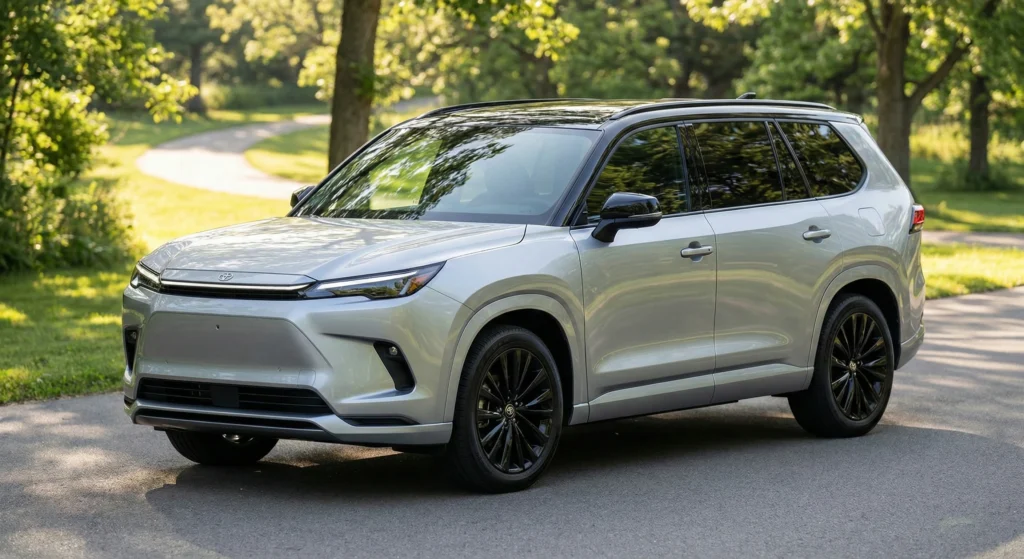
Toyota is making one of its boldest moves yet in the family SUV market. According to the latest industry reports, Toyota has unveiled a three-row Toyota Highlander EV, a fully electric version of one of America’s most popular midsize SUVs — and in the process, the company is expected to phase out the gas Highlander and Highlander Hybrid in favor of a battery-electric future.
This shift isn’t just a routine model refresh. It signals a major strategy change: Toyota is now preparing to compete directly with three-row electric SUVs like the Kia EV9 and the upcoming Hyundai Ioniq 9, while also giving loyal Highlander buyers a familiar name in an all-electric format.
Why Toyota Is Moving the Highlander to Electric Only
The Highlander has always been a practical, family-first SUV. For years, Toyota’s hybrid powertrain helped the model dominate buyers who wanted fuel efficiency without giving up space.

But the U.S. market has changed quickly. Three-row EVs are becoming the new “premium family vehicle,” and Toyota knows it can’t sit on the sidelines forever.
A Toyota three-row EV with the Highlander name gives the brand a huge advantage:
-
The Highlander is already trusted by families
-
Toyota’s reliability reputation is strong
-
EV buyers are now looking for space + range
-
Competitors are gaining ground in this segment
Toyota Highlander EV: What We Know So Far
While Toyota has not released every detail in one single spec sheet yet, early reports suggest the upcoming Toyota Highlander BEV will launch as a proper mainstream three-row electric SUV — not a niche product.
Expected Highlights:
-
Three-row seating for families
-
Front-wheel drive and all-wheel drive variants
-
A competitive range target to match or beat rivals
-
Faster charging with modern U.S. standards
-
A technology upgrade inside the cabin
Toyota Highlander EV Specs (Expected)
Here’s a clear snapshot of what is currently being reported for the 2027 Toyota Highlander EV.
| Category | Expected Details |
|---|---|
| Vehicle Type | Three-row electric SUV |
| Model Year | 2027 (expected) |
| Powertrain | BEV (Battery Electric Vehicle) |
| Drivetrain | FWD + AWD options |
| Range | Up to ~320 miles (higher trims) |
| Power | ~221 hp (FWD), up to ~338 hp (AWD) |
| Charging | NACS support (U.S. standard) |
| Production | Made in USA (Kentucky) |
| Launch Window | Late 2026 (expected) |
The Biggest News: Gas and Hybrid Highlander Could Be Ending
This is the headline that’s getting the most attention.
Multiple automotive sources are reporting that Toyota plans to eliminate both the gasoline Highlander and the Highlander Hybrid when the new electric generation arrives.
That means future Highlander buyers may have only one choice: the Highlander EV.
If Toyota confirms this officially, it would be a major turning point — especially because Toyota has historically leaned heavily on hybrids rather than full EVs.
How the Highlander EV Competes With Kia EV9 and Hyundai Ioniq 9
The three-row EV segment is heating up fast.
Toyota is stepping into a category already shaped by:
-
Kia EV9 (strong value, bold design)
-
Hyundai Ioniq 9 (expected high-tech focus)
-
Tesla’s rumored family SUV expansion
-
Future EVs from Ford and GM
Toyota’s strength won’t just be specs — it will be trust, resale value, dealer network, and reliability.
If the Highlander EV delivers a real-world range close to 300+ miles with fast charging, it could instantly become one of the most searched electric SUVs in the U.S.
Interior and Technology Expectations
Toyota has been improving cabin technology aggressively in recent years, and the Highlander EV is expected to bring major upgrades.
Possible features include:

-
Large infotainment screen (likely 14-inch)
-
Digital instrument cluster
-
Wireless Apple CarPlay and Android Auto
-
Toyota Safety Sense updates
-
Premium trims with panoramic roof
-
Multiple charging ports for families
For buyers, the key question is whether Toyota can combine EV technology with the Highlander’s classic practicality.
Made in USA: A Strategic Advantage
One of the most important details is production.
Reports indicate Toyota will build the Highlander EV in the United States, with batteries coming from Toyota’s North American supply chain.
That matters for:
-
Availability
-
Pricing stability
-
Faster deliveries
-
EV tax credit eligibility (depending on final rules)
This is a big step for Toyota’s EV expansion in North America.
Release Date and Expected Price
Toyota hasn’t officially published final pricing yet, but based on market positioning, the Highlander EV will likely be priced as a mainstream three-row electric SUV.
Expected Pricing (Estimates)
-
Starting price: $45,000–$52,000
-
Higher trims: $55,000–$65,000
Expected Release Window
-
Late 2026 (for 2027 model year)
If Toyota prices it aggressively, the Highlander EV could become one of the top-selling family EVs in America.
Should You Wait for the Toyota Highlander EV?
If you’re considering a family SUV upgrade, waiting could make sense — especially if you want:
-
A trusted three-row SUV
-
Toyota reliability with EV technology
-
Strong resale value
-
A competitive range with fast charging
However, if you need a vehicle immediately, current options like the Highlander Hybrid, Kia EV9, or other electrified SUVs may still be better choices today.
Final Words
The Toyota Highlander EV is shaping up to be one of the most important electric SUVs Toyota has ever introduced. If Toyota truly ends the gas and hybrid Highlander versions, it will be a bold and historic decision — one that pushes millions of mainstream buyers toward full electric driving.
For U.S. families who want space, comfort, range, and brand trust, the three-row Highlander BEV could become a top contender in the EV world as soon as it arrives.
